

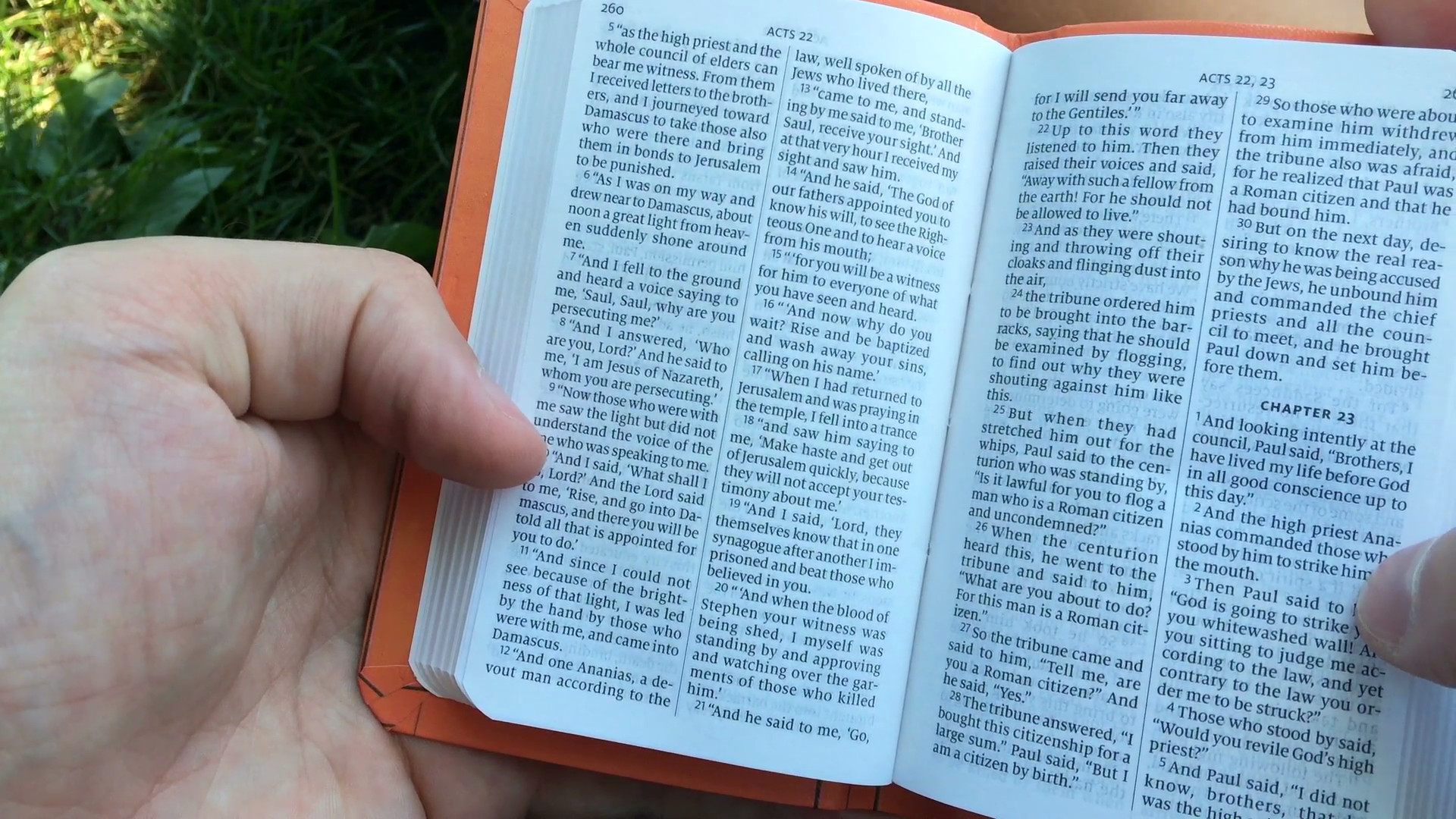
Shawn shares a question from a “new believer” about different Bible interpretations, especially regarding baptism:
I’m trying to explain to a new believer the different interpretations of the Bible. A stumbling point for him, for example, is why some churches preach that one must be baptized to be saved and some do not.
Hi, Shawn. Thanks for your question. Here’s a reply that will hopefully offer helpful guidance. I don’t know if I’ll provide anything more than you’ve already communicated to this new Christian, but I at least hope it will facilitate productive discussions going forward–to you and to anyone else who may be interested.
First, regarding different interpretations of the Bible.
Professing Christians certainly have different views on a variety of things (e.g., when and how Jesus will eventually return, the type of church government, speaking in tongues today, etc.) However, the historic core of Christian teaching—what C. S. Lewis referred to as “mere Christianity”—is essentially shared by every Christian tradition and every denomination. This important point is often overlooked or not adequately appreciated. The kernel of that historic core is expressed in Matthew 28:18-20 (often referred to as “The Great Commission”) and in 1 Cor. 15:1-8 (where St. Paul offers a short description of “the gospel,” which he and others were preaching).
In sum, Jesus told us to make disciples of all nations, baptize them, and teach them to observe all things he commanded. The gospel Paul received and preached focused on Jesus’ death, burial, resurrection, and post-mortem appearances. He goes on and talks about our resurrection as well in First Corinthians 15.
The historic core of Christianity is also summarized in the Apostle’s Creed and in the Nicene Creed (the theological statement issued at the Council of Nicea in AD325). For a brief overview of these creeds, CLICK HERE.
One take-away is that there is astonishing agreement on the core issues of faith. This means that, for the core convictions, Christians do NOT really have such different interpretations of the Bible. This should be encouraging to a new believer—or to an older one.
Second, regarding different views on baptism, here are some considerations to keep in mind:
- Baptism was clearly included in the Great Commission of Jesus shortly before his ascension into heaven (Matt. 28:18-20). And baptism is consistently commanded in the New Testament.
- Essentially every Christian group or tradition incorporates baptism as an important practice, so there is remarkable agreement on that.
- Christians primarily disagree on THREE things related to baptism: the WHO, the HOW, and the WHY.
1. The WHO of Baptism
Should baptism be administered to those mature enough to repent and believe, or can it be administered to infants? Churches that baptize infants include Roman Catholic, Eastern Orthodox, Lutheran, Methodist, and Presbyterian. Churches that require “believer baptism” include Baptist, Christian Churches and Churches of Christ, Pentecostal, and non-denominational evangelical.
The infant-baptizers view baptism as a moment when God’s forgiveness is granted through the sacrament (Catholic), or as a corollary to Jewish circumcision, which was typically administered to infants (Lk. 1:59; 2:21) (Presbyterian), or as a time when God grants a special grace to the infant that symbolizes God’s care toward eventual belief (Methodist). For Scriptural support, they also point to instances where baptism was given to entire “households” (Acts 16:15, 33-34).
The believer-baptizers focus more on the specific preaching and actual practice in the early church, which prominently feature the apparent prerequisites of belief and/or repentance (Mark 16:16; Acts 2:38; 8:12-13; 18:8). And the references to “household” are, at best, based on considerable inference.
2. The HOW of Baptism
Should baptism be by immersion or by sprinkling (or pouring)? Immersion is used by Baptists, Christian Churches and Churches of Christ, Eastern Orthodox, and Pentecostals. Sprinkling or pouring is used by Romans Catholics, Lutherans, Methodists, and Anglicans. (This is not an exhaustive list.)
Linguistically and historically, there’s little question that baptism was by immersion. The Greek word translated as “baptize” in the New Testament is baptizo, which means to dip or to plunge. (Interesting, the translators of one of the earliest and most influential English translations of the Bible, the King James Version in 1611, did not really translate the Greek word. Instead, they transliterated it, which means they coined a new English word by simply substituting English alphabet letters for Greek alphabet letters.)
Those who practice sprinkling or pouring typically contend that the word baptizo is sometimes used in contexts where the meaning is not definitive (e.g., Mark 7:4; Luke 11:38).
Those who practice immersion acknowledge that words can mean different things in different contexts—something we’re quite familiar with in English. But they emphasize the etymological meaning of the Greek word, which is to dip or plunge. Further, they point to other contexts that strongly indicate that baptism (baptizo) is a complete overwhelming or immersion that would require much water (John 3:23; Acts 8:38). The imagery of Romans 6:4 also describes how, in baptism, we are buried with Christ.
3. The WHY of Baptism
Does baptism have anything to do with the forgiveness of sins or not? Some hold that baptism is for the forgiveness of sins (Mark 1:4; Acts 2:38; 22:16). It’s part of the process of salvation. And notably, every account of conversion in the book of Acts included baptism (the large audience in Acts 2; the Samaritans in Acts 8; the Ethiopian in Acts 8; Saul in Acts 9; Cornelius in Acts 10; Lydia in Acts 16; the jailer in Acts 16).
Others claim that baptism has nothing to do with the receiving forgiveness of sins; instead, baptism is an outward sign of an inward grace. That is, it is an external sign that God has already forgiven. Probably the biggest reason why many take this view is that they see baptism as a “work.” And the Bible clearly says that salvation is by faith (or grace), not by works (Rom. 3:28; 11:5-6; Gal. 2:16; Eph. 2:8-9).
In response, those who see baptism “for the forgiveness of sins” do not see it as a “work”—as though the act itself somehow saves us or that, by doing enough works, we can be saved. It’s not actually a work we do; it something that, in faith and surrender, we allow to be done to us. To be sure, baptism is an external expression of a deeper inner faith and commitment to the lordship of Christ. And the biblical narratives in the book of Acts strongly suggest that baptism at the time of repentance and conversion was normative–that is, baptism should be integral to the conversion process. Baptism was a critical component in the “package” of initial conversion.
Part of the problem is that the New Testament does not neatly separate baptism from the act of faith. Today, however, we are asking questions, or imposing positions, that the New Testament does not explicitly address. For example, is someone saved by faith prior to baptism? Is someone saved who was sprinkled rather than immersed? “Baptism has nothing to do with the forgiveness of sins.” According to the New Testament, conversion requires surrendering faith to God and confession of Christ; and baptism was part of that normative, holistic process of conversion.
The bottom line is that there are different interpretations of some facets of baptism; yet there is still universal agreement on the importance of baptism and doing it as an act of faith and surrender to a God of grace.
The issue of baptism illustrates that first point about focusing on the core elements of the Christian faith. It’s not that other issues are not important. But the differences in interpretation on these matters should be held in love for one another and always with the intent of giving Scripture its supreme authority to lead us. And that poses a critical issue: what authority determines the answers to all these questions? Is it primarily some kind of church tradition or declaration, or is it biblical preaching and precedent? Of course, it’s not a totally black or white issue. But the issue of authority should always be contemplated and pursued with prayer for wisdom.
I find it especially interesting that the book of Acts describes a man named Apollos who taught about Jesus accurately, but he did not have an accurate view about baptism. But Priscilla and Aquilla invited him into their home “and explained the way of God more accurately” (see Acts 18:24-28). That should be our passion and pursuit: In love, to help others; and in humility, to be open to receive help from others, especially when it comes to understanding the teaching of Scripture.
~ Dr. Richard Knopp